
A new airline water study suggests the real inflight risk may be what’s in your cup
Reading Time: 3 minutes
Airlines would like you to believe the biggest threat to your inflight experience is a reclining seatmate or a gate agent announcing a “short delay” that somehow lasts 90 minutes. But according to a new 2026 airline water study, the real danger may already be in your cup.
The study, released by the Center for Food as Medicine and Longevity, found that drinking water quality varies wildly by airline, and that many carriers continue to serve water that may be unsafe for consumption. Not “suboptimal.” Not “less than ideal.” Potentially unhealthy.
Which raises an uncomfortable question:
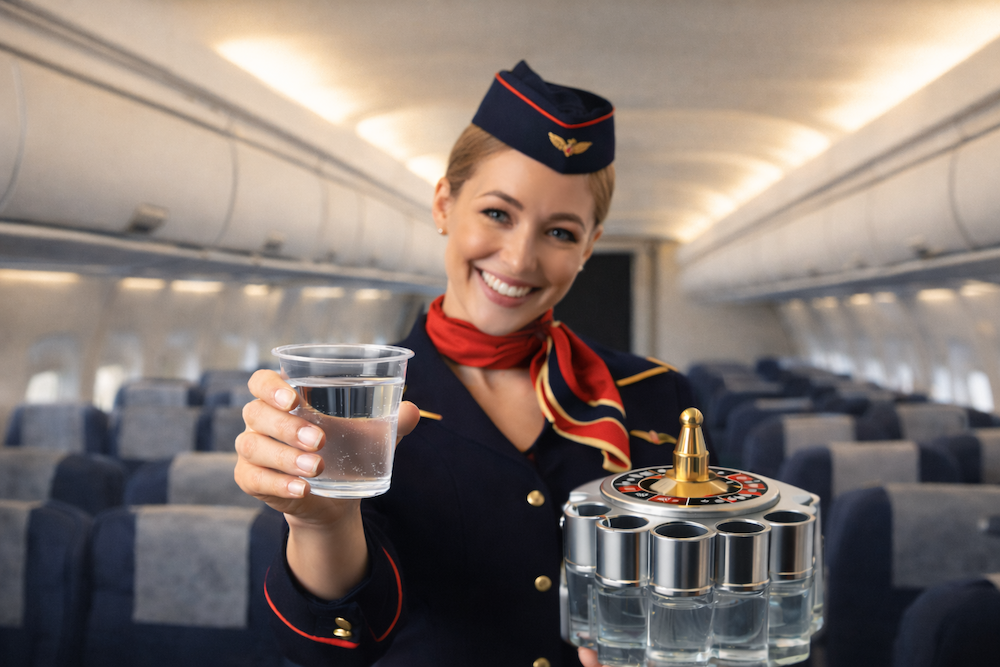
How did we normalize flying as an exercise in hydration roulette?
Skip the Coffee — Bring Your Own Water
The Center’s advice reads less like a wellness tip sheet and more like guidance for surviving a post-apocalyptic transit system:
• Never drink onboard water unless it’s from a sealed bottle.
• Skip the coffee and tea entirely.
• Avoid washing your hands in the bathroom—use hand sanitizer instead.
Let’s pause on that last one. You are on a $70 million aircraft, cruising at 35,000 feet, powered by some of the most advanced engineering on earth—and the official recommendation is don’t use the sink.
Somehow, this is considered normal.
The study assigns water safety scores on a 0–5 scale. And the results are… revealing.
At the top of the hydration food chain:
• Delta Air Lines earns a pristine 5.00 (Grade A).
• Frontier Airlines follows with 4.80 (Grade A).
In the respectable-but-not-exactly-reassuring B grade:
• Alaska Airlines (3.85)
• Allegiant Air (3.65)
• Southwest Airlines, Hawaiian Airlines, and United Airlines hover around the C range
And then there’s the group you really hope didn’t make your coffee:
• Spirit Airlines (2.05)
• JetBlue (1.80)
• American Airlines (1.75)
This isn’t a mystery of physics. It’s a management choice. Some airlines figured this out. Others… did not.
A Pro’s Travel Hack
Frequent flyers already know the drill. Bring your own bottle. Decline the coffee. Smile politely at the flight attendant and then quietly protect yourself.
But when your customers are forced to work around your core services to stay healthy, you don’t have a savvy user base—you have a broken system.
This isn’t about passengers being “more informed.” It’s about airlines quietly offloading risk onto travelers while marketing comfort, care, and premium experience. You can install all the mood lighting you want; if the water system inspires distrust, the brand promise collapses.
The Infrastructure Item No Airline Wants to Talk About
Airlines love big, shiny investments: biometric boarding, AI-driven pricing, lie-flat seats with doors. Water systems? Not sexy. No Instagram payoff. No loyalty-point multiplier.
But water is the most basic form of hospitality. And right now, it lives in a regulatory and accountability no-man’s-land, maintained just well enough not to cause a headline, but not well enough to earn trust.
That’s not innovation. That’s neglect with good PR.
For business travelers, this isn’t just gross—it’s operationally dumb. Dehydration, illness, and hygiene failures don’t improve productivity, wellness, or performance. And for an industry that loves to talk about trust and safety culture, asking passengers to bring their own water feels like an admission no one wants to make out loud.
The fix isn’t glamorous. It doesn’t involve apps or upgrades. It involves maintenance, testing, transparency, and treating water like what it is: a core part of the passenger experience, not a background utility travelers are expected to navigate at their own risk.
Until then, the safest drink on board remains the one you bought at the terminal.
Cheers to that.
Any thoughts, opinions, or news? Please share them with me at vince@meetingsevents.com.
Photo by ChapGPT